Water Marks on Windows: How to Remove Them (and Prevent Them)
Those cloudy spots aren't dirt — they're minerals bonded to the glass. Here's how to safely remove water marks on windows before they permanently etch.
Water marks on windows aren't a cleaning problem — they're a chemistry problem. Those hazy, cloudy, or spotted patches are calcium, magnesium, and silica deposits left behind when sprinkler overspray, marine layer, or hose runoff evaporates on the glass. Standard window cleaning won't touch them. Here's what actually works and what to avoid.
What causes water marks on windows?
- Sprinkler overspray hitting the glass day after day
- Hose water rundown when washing cars or driveways
- Marine layer and coastal mist evaporating on the glass
- Rain flow patterns off dirty rooflines
- Pool splash and spa overspray
The three stages of hard-water damage
- Stage 1 — Fresh spotting: minerals sitting on the surface. Removable with a standard hard-water treatment.
- Stage 2 — Bonded deposits: minerals chemically bonded to the glass. Removable with a professional mineral-dissolving compound plus non-scratch agitation.
- Stage 3 — Permanent etching: the acid produced by trapped minerals has actually pitted the glass. Not fully reversible — the glass is physically damaged.
How professionals remove water marks on windows
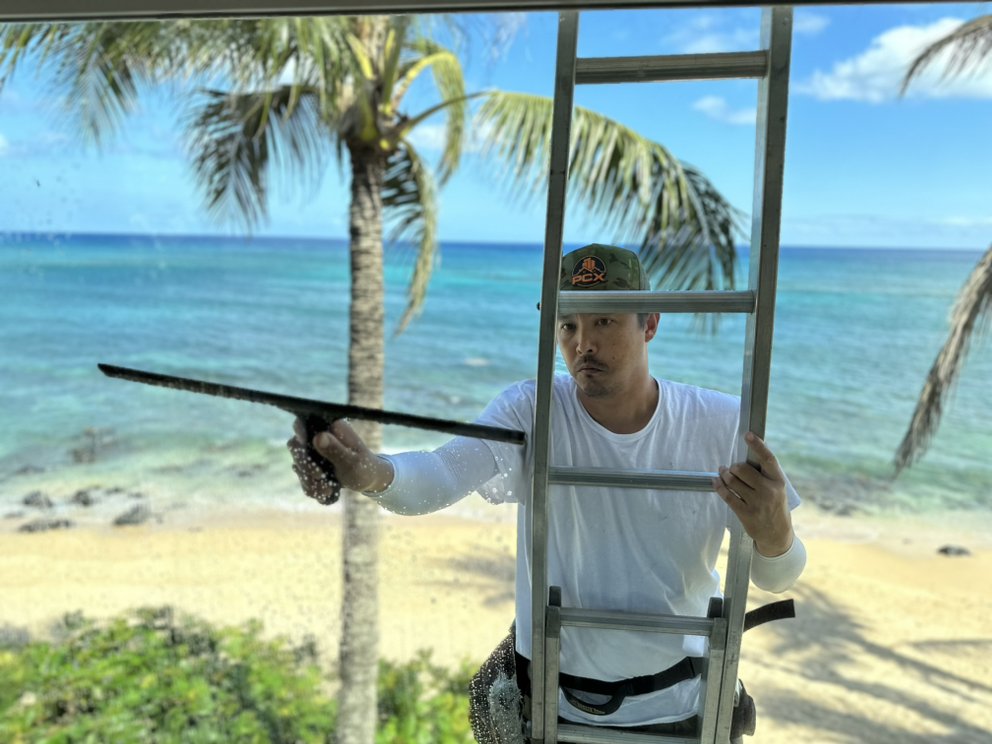
We start with a fingernail test — if you can feel the deposit as a rough patch, it's stage 2 or 3. Stage 1 and 2 are treated with a mineral-dissolving compound applied with non-scratch pads in small sections, then flushed with pure water. Every pane is inspected in raking light to catch missed spots. For stage 3 etching we're honest — some improvement is possible but it won't be fully invisible.
What NOT to do
- Don't use steel wool or razor blades on stage 1 or 2 spots — you'll add scratches to the mineral damage
- Don't use acid-based products without knowing your window coatings (low-E and tinted glass react)
- Don't wait — the longer minerals sit, the deeper the bond and the harder the removal
Preventing water marks from coming back
- Redirect sprinkler heads so they never spray the glass
- Install a hydrophobic glass coating (lasts 12–24 months) so water beads off instead of drying on
- Squeegee shower and slider glass after use
- Schedule quarterly window cleaning if you're on the coast or near irrigation
Frequently asked questions
Are water marks on windows permanent?
Not usually — stage 1 and 2 (surface and bonded deposits) are removable. Stage 3 (etched glass) is physical damage and only partially recoverable.
Can I remove water marks myself with vinegar?
Vinegar and Bar Keepers Friend can lift very fresh stage 1 spots. Anything bonded needs a professional-grade mineral dissolver applied correctly.
How much does hard-water removal cost?
Typically $75–$200 per affected elevation depending on severity. Whole-home restorations for badly etched glass run $500–$1,500.